

Handcrafted French cutlery: expertise, burl wood, and bog oak
French cutlery craftsmanship spans centuries without losing any of its evocative power. Behind every forged blade, every patiently shaped handle, there is the trace of a learned, transmitted, sometimes reinvented gesture. Cutlers from Jura, Thiers, Laguiole, or Nontron continue to work like their predecessors, giving the same care to raw material as to the final detail. This article offers an overview of this world, from artisanal forging to the selection of the rarest burl woods, including morta from the Breton marshes, a fossil wood that has become the signature of some exceptional blades.
For those who wish to discover a complete selection of handmade pieces, the website couteau artisanal français presents a living showcase of current expertise, with folding models crafted from rare woods and hand-finished.
The expertise of French cutlers
French cutlery relies on a network of human-scale workshops, often rooted in historical basins. Thiers, in Puy-de-Dôme, still concentrates a significant part of national production today, with an industrial heritage dating back to the 15th century. Laguiole, in Aveyron, has become a generic appellation but corresponds to a very precise tradition when the pieces actually come from a local workshop. Nontron, in Dordogne, perpetuates the manufacture of the oldest French folding knife, identified since the 16th century.
Jura workshops, a living tradition
Jura does not have the notoriety of Thiers, but it is home to demanding cutlery, often organized around independent artisans. The proximity of forest massifs has long facilitated the supply of precious wood for handles, while the watchmaking culture of the neighboring Haut-Doubs has spread a certain rigor of execution. Jura cutlers generally work on order, in small series or unique pieces, with particular attention paid to adjustments and finishes.
Artisanal forging, a foundational gesture
Everything starts with the blade, and every blade worthy of the name begins with forging. The cutler heats the steel to red hot, hammers it to orient its internal structure, then quenches it before tempering. These steps determine the final hardness, the ability to hold a sharp edge, and resistance to corrosion. The steels used vary according to the workshops: XC75 carbon, Sandvik 12C27 stainless, multi-layer Damascus obtained by successive welding and folding. Each choice corresponds to a compromise between hardness, ease of sharpening, and long-term stability. According to the French Cutlery Federation, more than 90% of knives manufactured in France use steels of European origin, ensuring complete traceability.
The burl wood handle, signature of beautiful blades
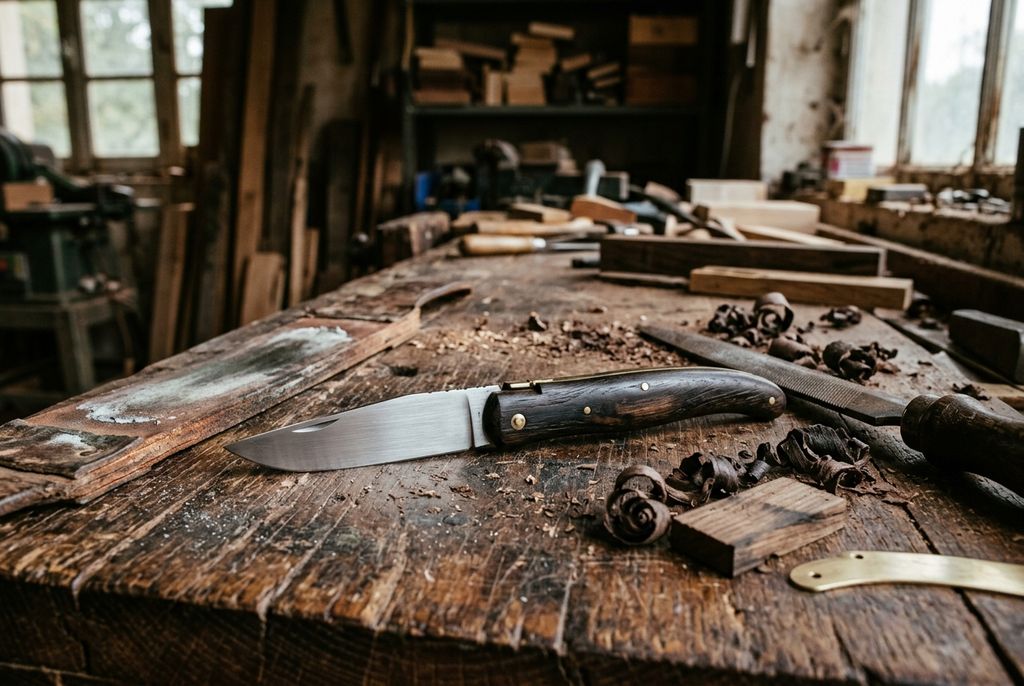
If the blade makes the knife, the handle makes the piece. It is what fits in the hand, that acquires a patina with skin contact, and carries the visual signature of the object. High-end cutlers favor dense, stable, and richly veined woods, among which burls occupy a special place.
Burl wood, what exactly is it?
A burl is an outgrowth that forms on the trunk or roots of a tree, usually in reaction to stress, injury, or parasitic attack. The resulting wood has a disorganized structure, made of intertwined fibers in all directions. This anarchy produces spectacular patterns, marbled, wavy, sometimes studded with small dark eyes. The most sought-after burls in cutlery come from amboyna, thuya, briar, walnut, or maple. Stabilized with resin to resist humidity, these woods become both resistant and sumptuous.
Morta, fossil wood from the Breton marshes
Morta occupies a specific category. It is subfossil marsh oak, preserved for several thousand years in peat bogs and wetlands, particularly in Brittany and the Marais poitevin. According to carbon-14 dating published by the National Museum of Natural History, some specimens are over 5000 years old. Prolonged contact with oxygen-poor water, rich in tannins and mineral salts, gradually transforms the wood. Its color darkens, its density increases, and its dimensional stability improves. Extracted, dried, and worked morta becomes a deep black material, sometimes crossed with brown or bluish reflections, which is particularly well suited for knife handles. Its rarity and the complexity of its extraction explain its high price, but also its unique character: no two pieces are identical.
Recognizing high-end French cutlery
The folding knife market is saturated with pieces stamped as French but assembled from imported components. To distinguish true artisanal production, several benchmarks cross-reference. The first is transparency regarding the origin of the steel and wood used, generally detailed by the workshop on its product sheet. The second is the existence of variations between pieces: a burl or morta handle that is truly natural will never be identically reproducible, unlike uniform composite materials.
Concrete indicators of quality
A correctly heat-treated blade shows a regular edge, without micro-chips after sharpening. Screws, springs, and pivot pins must be adjusted without lateral play, with a clear opening and firm locking. Welds, where they exist, are clean and homogeneous. The polish of the sides, the regularity of the chamfers, the quality of the adjustments between plates and handles are all visible markers. INSEE lists nearly 200 cutlery workshops in France in 2024, about thirty of which are considered craftspeople in the regulatory sense.
Why support French cutlery craftsmanship
Beyond intrinsic quality, buying a French artisanal knife helps keep a technical heritage alive. Workshops in Thiers, Jura, or Nontron train new apprentices each year, transmit gestures that industry cannot reproduce, and preserve know-how threatened by Asian competition. Choosing a handmade piece also means opting for an object that lasts, that can be maintained, that can be passed down, as opposed to industrial knives often discarded after a few years of use.
Frequently asked questions about artisanal knives
How much does a French artisanal knife cost?
Prices vary depending on the complexity of the piece and the rarity of the materials. An artisanal folding knife with a stabilized wood handle starts around 150 euros, while a model in rare burl or morta can exceed 600 to 1000 euros. Pieces signed by recognized cutlers, or limited editions in Damascus, regularly reach several thousand euros on the secondary market.
How to care for a knife with a burl or morta wood handle?
Resin-stabilized woods do not require specific treatment. Wiping after use and storing away from prolonged humidity are sufficient. For oiled woods, an annual application of boiled linseed oil or camellia oil preserves the appearance and natural patina. The blade is sharpened on a water stone or diamond sharpener, according to the original angle, generally between 18 and 22 degrees per side.
Is morta wood or a fossil?
Morta is technically subfossil wood: it has begun a fossilization process without completing it. Its composition remains organic, but profoundly modified by thousands of years spent in peat. It works like hardwood, but with well-sharpened tools due to its higher density than fresh oak.
Sources
French Cutlery Federation, 2024 production data. National Museum of Natural History, carbon-14 dating of Breton subfossil oaks. INSEE, census of craft trades and cutlery 2024.
