


Touch-sensitive plasma lamp, 10 to 20 cm plasma ball - FULGUR
🚚 FREE DELIVERY
Tax included
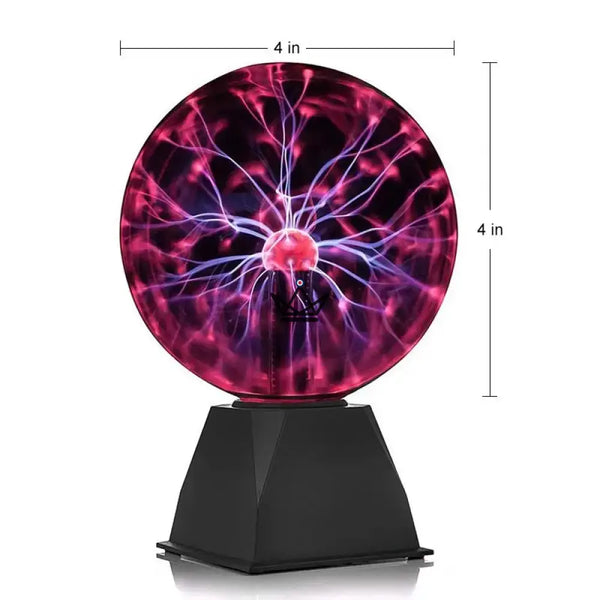
Plasma lamp Touch-sensitive Place your finger on the glass, and the lightning comes to meet you. The FULGUR touch-sensitive plasma lamp encloses within a glass sphere a central electrode from which violet and pink luminous filaments spring, undulating, branching out, and moving incessantly. Bring your hand close: the arcs immediately converge toward your fingers, as if drawn by your presence. This spectacle is based on a principle discovered in the wake of Nikola Tesla's work on high frequencies at the end of the 19th century. FULGUR is available in four diameters, from 10 to 20 cm, all presented on a black pyramidal base and powered by a European mains plug. An object of fascination for young and old alike, the plasma lamp is also a spectacular ambient nightlight and an timeless classic for the cabinet of scientific curiosities we assemble at the Lab.
The four diameters
How lightning is born in a glass sphere
A plasma lamp is a glass sphere filled with a mixture of noble gases at low pressure. In the center, an electrode is powered by a small circuit that produces a high-frequency, high-voltage alternating current. This electric field strips electrons from the gas atoms: the gas becomes a plasma, the fourth state of matter, and emits light as it de-excites. The colored filaments are channels where the current flows between the electrode and the glass wall.
When you touch the sphere, your body provides this current with an easier path to the ground: the filaments then concentrate toward your fingers. The idea descends from Nikola Tesla's experiments on high-frequency currents conducted in the 1890s; the plasma lamp as we know it appeared in the 20th century and became popularized in the 1980s.
Why you will love it
Taming the lightning
Lightning has always fascinated as much as it has frightened. At the end of the 19th century, Nikola Tesla unleashed artificial lightning in his laboratory and dreamed of transmitting energy wirelessly. His public demonstrations, where he held glowing tubes in his hands, left a lasting impression. The plasma lamp is the domestic heir to these experiments: a miniature storm, enclosed and tamed, that can be touched without fear.
Off, FULGUR is a sober glass sphere resting on its black base. On in the dim light, it becomes hypnotic. The filaments twist, divide, and crawl along the glass; your hand approaches, and suddenly the light responds to it. There is in this dialogue something profoundly magical and perfectly scientific at the same time — exactly what gives the most beautiful objects of curiosity their appeal.
Set up in 4 steps
Which diameter to choose?
| Diameter | Power supply | Base | Recommended usage |
|---|---|---|---|
| 10 cm | EU mains plug | Pyramidal, black | Bedside table, desk |
| 12.5 cm | EU mains plug | Pyramidal, black | Shelf, console, teenager's room |
| 15 cm | EU mains plug | Pyramidal, black | Living room, game room |
| 20 cm | EU mains plug | Pyramidal, black | Centerpiece, spectacular effect |
Good to know: the glass may warm up slightly after a long period of operation, and it is normal to perceive a faint buzzing or a very slight tingling sensation if you bring a metal object close. The darker the room, the clearer and more colorful the filaments appear. Discover other light phenomena in our light and levitation collection.
Tip: to preserve the lamp, limit sessions to a few hours at a time and turn it off when you leave the room. Dust the sphere, with the lamp unplugged and cooled, using a soft, dry cloth: clean glass makes the filaments easier to see.
Experiment to try: in the dark, bring a fluorescent tube or an energy-saving bulb turned off a few centimeters from the sphere, without contact: it may begin to glow faintly, a sign of the high-frequency electric field surrounding it.
Technical specifications
| Type | Touch-sensitive plasma lamp (plasma ball) |
| Diameters | 10 cm, 12.5 cm, 15 cm, 20 cm |
| Sphere | Glass, central electrode |
| Filament color | Violet and pink |
| Function | Touch-sensitive |
| Base | Pyramidal, black |
| Power supply | European mains plug, 220 V |
| Plasma bulb | Included |
| Weight | Not communicated |
Precautions: the plasma lamp produces a high-frequency electric field. It is not recommended for people with a pacemaker or an implantable defibrillator. Never place a metal or electronic object (phone, watch, keys) on or against the sphere, and keep it away from sensitive devices: interference is possible. Do not touch the glass with a metal object, do not use the lamp if the sphere is cracked, and keep it away from humidity. Use by children must be under adult supervision.
An electrifying gift
A birthday for a curious child, a teenager's room, Christmas, an end-of-year gift for a physics teacher, or a nod to a science enthusiast: the plasma lamp is a gift that unfailingly elicits a "wow" the first time it is turned on. The large formats will delight fans of retro-futuristic objects; the 10 cm one easily finds its place on a nightstand.
To extend the wonder, explore the Lab, our world of scientific objects, or our light decoration ideas.
Frequently asked questions
How does a plasma lamp work?
The glass sphere contains a mixture of noble gases at low pressure. The central electrode is powered by a circuit that generates a high-frequency high alternating voltage. This electric field ionizes the gas, which becomes a plasma and emits light: these are the violet and pink filaments you see starting from the center toward the wall. They move constantly because the current is always looking for the easiest path through the gas. The principle is in line with Nikola Tesla's experiments on high-frequency currents at the end of the 19th century.
Why do the filaments follow my hand?
When you place your hand on the sphere, your body offers the current an easier path than the glass alone to reach its surroundings. The plasma filaments then concentrate toward the point of contact and form a brighter beam under your fingers. This phenomenon is harmless under normal use: the current flowing through the glass wall is extremely weak. It is precisely this interaction that makes the lamp charming: it reacts to your presence and turns a simple gesture into a physics experiment. Try it with several fingers, or both hands, to see the arcs divide.
Which diameter to choose?
It all depends on the use and placement. The 10 cm version, the most compact, sits easily on a desk or nightstand. The 12.5 cm version offers a nice balance for a bedroom, shelf, or console. The 15 and 20 cm models, more imposing, feature longer arcs and become the centerpiece of a living room or game room. The larger the sphere, the ampler the spectacle. All versions plug into a European mains socket.
How is the lamp powered?
The four versions, 10, 12.5, 15, and 20 cm, plug directly into a European 220 V mains socket: no adapter is needed in France. There are no batteries to worry about, and the plasma bulb is included: just plug the lamp in to enjoy the show. Place it near a socket, on a flat, stable surface, ensuring the cable is not taut or placed in a passageway where someone might trip. Turn it off or unplug it when you leave the room for a long time.
Is the plasma lamp safe?
Used normally, the plasma lamp is a safe decorative object: the glass insulates the plasma and the current felt upon touch is extremely weak. However, some precautions are necessary. It is not recommended for wearers of a pacemaker or an implantable defibrillator. Never place a metal or electronic object on the sphere, and keep it away from phones, computers, and sensitive devices, as interference is possible. Do not use a lamp with cracked or broken glass. Finally, use by children should be done under adult supervision, and the lamp must be kept away from humidity.
Can you change the color of the filaments?
No, the color of the filaments cannot be adjusted. It depends on the composition of the gas mixture trapped inside the sphere, which determines the wavelength of the light emitted. On this lamp, the filaments exhibit violet and pink hues, the classic colors of plasma lamps. The lamp is touch-sensitive, but does not offer a music mode or color change. Its interest lies in the natural beauty of the phenomenon: arcs that move freely and react to your hand, without programming or artificial effect. It is physics, and physics alone, that creates the show.
How do I maintain the plasma lamp?
Always unplug the lamp and let it cool before cleaning. Dust the sphere and base with a soft, dry cloth; do not use water, household products, or alcohol, which could seep into the electrical base. Handle the sphere with care: the glass is fragile and should not be subjected to any impact. Avoid long periods of continuous operation and turn off the lamp when you leave the room, which preserves its circuit. Also unplug it if you do not use it for several weeks.
