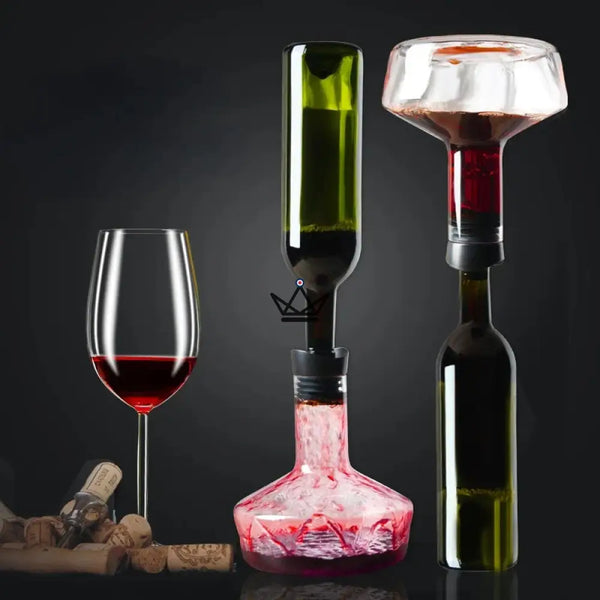
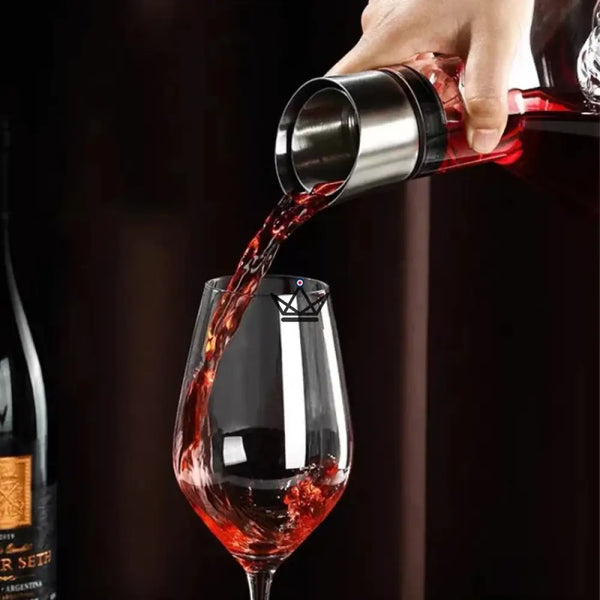
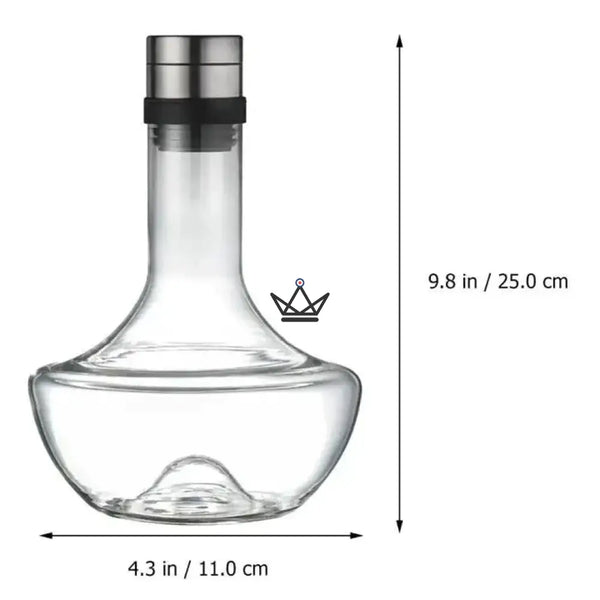
The Reverse Decanter completely reinvents the traditional decanting process thanks to its patented inversion system. Rather than manually transferring your wine from bottle to decanter—a slow, risky, and often clumsy operation—the Reverse's silicone and stainless steel stopper screws directly onto your bottle neck. You then simply invert the entire assembly: the wine flows by gravity into the decanter, creating a swirling motion that maximizes its contact surface with the air, allowing for complete aeration in just 3 minutes. The stopper also retains any deposits and sediments, ensuring clear serving. High-quality glass, 1-liter capacity (ideal for a 75 cl bottle), dimensions 25 × 11 cm. An oenological innovation that transforms the at-home wine experience.
How to decant in 4 steps
1
Open your bottle
Remove the traditional cork and place the bottle upright on a stable surface. Ensure the Reverse Decanter is clean and dry.
2
Screw the Reverse stopper onto the bottle
Insert the silicone neck of the decanter directly onto the bottle's neck—the silicone perfectly fits standard bottle necks and ensures a complete seal.
3
Invert the entire assembly
With a firm motion, invert the bottle and decanter together so that the bottle is on top and the decanter below. The wine begins to flow by gravity, swirling—allow 3 minutes for optimal aeration.
4
Invert again, serve and enjoy
Once the wine is fully transferred and oxygenated, invert the assembly again to return the decanter to its normal position. Remove the empty bottle, serve, and savor a perfectly aerated wine.
◆
Decanting in 3 minutes
Express complete aeration thanks to the swirling motion generated by gravity
◆
No manual transfer
The silicone stopper screws onto the bottle—no more risky maneuvers or splashes
◆
Integrated filtration
The stopper retains deposits and sediments for a clear and refined service
◆
Maximum aeration
The swirling motion exposes every drop to air contact to release aromas
◆
High-quality glass
Thick blown crystal that enhances the wine's color and withstands intensive use
◆
1 liter capacity
Ideal for a standard 75 cl bottle with optimal oxygenation margin
Why decanting transforms wine
Wine trapped in its bottle for months, or even years, is in a state of aromatic reduction—its tannins are tight, its aromas closed, its structure rigid. This is particularly true for powerful reds, young grand cru wines, and wines meant for aging. Decanting involves exposing the wine to oxygen to release its aromas, soften its tannins, and reveal the complexity that the bottle alone masks. But traditional decanting is slow (often 30 minutes to several hours depending on the wine) and technical (precise transfer to avoid deposits). The Reverse Decanter solves both problems with a simple innovation: direct inversion from the bottle generates intense agitation that multiplies air-wine contact, drastically accelerating oxygenation. Three minutes are enough where thirty were previously needed. And the stopper retains deposits for you. The oenological ritual finally becomes accessible for everyday use.
Reverse vs. Traditional Decanting
The comparison table clarifies the innovation of the Reverse method.
| Criterion |
Traditional Decanting |
Reverse Method |
| Aeration Time |
30 minutes to several hours |
Only 3 minutes |
| Transfer Action |
Manual, slow, risky |
None — direct screw-on to bottle |
| Deposit Management |
Manually done by prior decantation |
Integrated filtration by the stopper |
| Possible Splashes |
Real risk during transfer |
None — hermetic system |
| Oxygenation Intensity |
Air-wine contact limited to the surface |
Full swirling agitation |
| Expertise Required |
Sommelier's technical skill |
Accessible to all, intuitive |
Which wines benefit from decanting with the Reverse? Almost all structured red wines benefit from decanting, but certain profiles gain spectacular advantages. Powerful young red wines (Bordeaux under 5 years, Côtes-du-Rhône, young Châteauneuf-du-Pape): decanting softens tight tannins and reveals fruit. Aged grand cru wines (Burgundy, classified Bordeaux): allows appreciation of a great wine without waiting decades. Structured New World wines (Californian Cabernet, Argentinian Malbec, Australian Shiraz): releases their candied fruit and woody notes. Tannic grape varieties (Tannat, Mourvèdre, Nebbiolo): essential softening. Rich and oaky white wines (oaked Chardonnay, old Riesling): yes also, but briefly (1-2 minutes is enough). To avoid: very old and fragile wines (which can become flat too quickly), delicate Pinot Noirs, sparkling wines.
Care advice. To preserve the transparency of the glass and the effectiveness of the stopper in the long term, follow these simple rules. Decanter cleaning: rinse immediately after each use with lukewarm water, then gently clean with a long-handled decanter brush to reach the curved bottom. Avoid aggressive detergents that leave odor residues altering the aromas of subsequent wines. For stubborn tannin stains, use a few grains of coarse salt with a little water and shake gently—a very effective traditional sommelier method. Stopper cleaning: wash the silicone and stainless steel stopper with warm soapy water, dry completely before storing. Decanter drying: invert it on a specific decanter drying rack or hang it neck down for complete drying without water marks.
| Product Type |
Decanter with patented direct inversion system |
| Dimensions |
25 cm × 11 cm |
| Capacity |
1 liter — suitable for a standard 75 cl bottle with aeration margin |
| Decanter Material |
High-quality glass |
| Stopper Material |
Silicone (adaptable neck) + stainless steel (upper part) |
| Decanting Duration |
3 minutes for complete aeration |
| Bottle Compatibility |
All standard wine bottle necks on the market |
| Deposit Filtration |
Integrated into the stopper — naturally retains sediments |
| Decanting Type |
By inversion and swirling agitation |
| Aeration Generated |
Maximum — air-wine contact over the entire flow surface |
| Usage Level |
Accessible to all, no sommelier expertise required |
| Preferred Use |
Structured red wines, young grand cru wines, home tastings |
Usage precautions. The Reverse Decanter is made of high-quality glass but remains fragile to impacts and falls—always handle it with care, especially during the inversion step where the bottle+decanter assembly reaches a significant weight. Inversion motion: perform it with a firm and continuous motion rather than in jerks, to avoid splashes and instability. Hold both elements firmly during rotation. Bottle compatibility: the silicone stopper is designed for standard wine bottle necks—which represent the vast majority of the market—some bottles with atypical necks (very wide or very narrow, like certain traditional Portuguese or Italian wines) may not fit perfectly. Thermal shock: never place the decanter directly from the refrigerator onto a hot surface, and vice versa—the glass may crack. Dishwasher: not recommended to preserve the transparency of the glass and the elasticity of the silicone in the long term.
The oenology gift that truly changes the wine experience. The Reverse Decanter is for wine lovers who appreciate beautiful functional objects and useful innovations. Unlike many cellar accessories that remain decorative, the Reverse is actually used at every tasting and immediately transforms the act of decanting. Ideal for enthusiasts equipped with classic oenological tools (glasses, corkscrew, champagne bucket) who are now looking for a modern innovation. Particularly appreciated by enthusiasts with well-stocked cellars who often open their young grand cru wines and want to enjoy them without waiting 30 minutes for traditional decanting. A perfect gift for birthdays, Father's Day, retirements, housewarmings, or simply as a thoughtful gesture for a dinner among enthusiasts. For a complete gift, pair the Reverse Decanter with a young vintage wine bottle—the recipient can enjoy it immediately thanks to your combined gift.
Frequently Asked Questions
How does inversion allow decanting in just 3 minutes?
Traditional decanting oxygenates wine only through its contact surface with air in the decanter—a slow process that takes 30 minutes to several hours depending on the wine. The Reverse method works differently: during inversion, the wine swirls in the decanter by gravity, creating an intense movement that exposes every drop to air contact in the form of fine bubbles and turbulence. This agitated flow aeration is exponentially more efficient than static surface aeration. The result: what classic decanting takes half an hour to achieve, the Reverse accomplishes in 3 minutes with superior oxygenation quality.
Does the stopper really retain deposits?
Yes, the silicone stopper incorporates a natural filtration system that retains sediments and deposits as the wine passes from the bottle to the decanter. This is particularly useful for aged wines that naturally develop deposits at the bottom of their bottle, or for unfiltered wines (increasingly common in organic and natural domains). Important: for very old wines with particularly abundant deposits, we still recommend letting the bottle stand upright for 24 hours before decanting to allow most of the deposit to settle to the bottom, then using the Reverse normally. For typical young wines, the stopper's integrated filtration is largely sufficient.
Does the Reverse Decanter fit all bottles?
The silicone stopper is designed to fit standard wine bottle necks, which represent the vast majority of the market (Bordeaux, Burgundy, Rhône, German Rhine/Moselle bottles, New World bottles). A few atypical traditional formats may have particularly wide or particularly narrow necks that do not fit as perfectly—this is the case for certain Portuguese wines (traditional Port), some old Italian bottles, or bottles particularly characteristic of their region of origin. In these cases, you can still use the decanter by classic transfer. But for 95% of your cellar, the system works perfectly.
Should all wines be decanted?
No, and it's important to know this. Wines that benefit from the Reverse decanting method: young and structured red wines (Bordeaux, Côtes-du-Rhône, Languedoc, New World wines), young Grand Cru wines that are meant for aging, very tannic wines (Tannat, Nebbiolo, Mourvèdre). Wines that may benefit but only briefly: rich and oaked white wines (oaked Chardonnay, old Rieslings for aging) – 1 to 2 minutes are sufficient. Wines NOT to decant or to do so with extreme caution: very old and fragile wines (can oxidize too quickly and lose their aromas in a few minutes), delicate Pinot Noirs (old Burgundy), sparkling wines (champagnes, cavas, prosecco). If in doubt about a fine old wine, ask your wine merchant for advice before decanting.
What is the difference between this and a classic wine aerator?
Classic aerators are small accessories placed on the neck of the bottle at the time of serving, oxygenating the wine as it flows directly into the glass. Advantage: quick and discreet. Disadvantage: oxygenation is limited to a few seconds of contact, and it's impossible to serve directly at the table without going back to the bottle. The Reverse Decanter offers a complementary approach: complete decanting of the entire bottle in 3 minutes, then serving at the table directly from the decanter (an elegant decorative object). You get both much more intense aeration and superior serving elegance. Enthusiasts often own both for different uses: an aerator for an impromptu single glass, the Reverse Decanter for a meal with company.
How do I properly clean the Reverse Decanter?
Cleaning requires some precautions to preserve the glass's transparency and the stopper's effectiveness. Step 1: rinse immediately after each use with lukewarm water to prevent wine from drying and leaving stubborn stains. Step 2: clean the inside with a flexible long-handled decanter brush – essential for reaching the rounded bottom that your fingers cannot touch. Step 3 (stubborn stains): use the traditional sommelier method – a few grains of coarse salt with a little water, shake gently; the salt acts as a gentle abrasive. Step 4 (stopper): wash the silicone and stainless steel stopper with lukewarm soapy water, rinse, and dry completely. Avoid: dishwashers (preserves transparency long-term), scented detergents (leave fragrant residues), boiling water (potential thermal shock).
Is the glass really durable?
Yes, the Reverse Decanter is made of high-quality glass, which is thicker and more resistant than many standard decorative decanters. This glass quality easily withstands regular use, daily handling, and the weight of the bottle+wine combination during inversion. However, like all glass, it remains fragile to impacts and drops – avoid placing it roughly on hard surfaces, knocking it against other glasses during washing, or exposing it to sudden thermal shocks (e.g., taking it out of the freezer and placing it on a hot surface). With normal and careful use, the Reverse Decanter will accompany you for years of tastings.