


Ferrofluid speaker that dances to the rhythm of the music - ONDA
🚚 FREE DELIVERY
Tax included
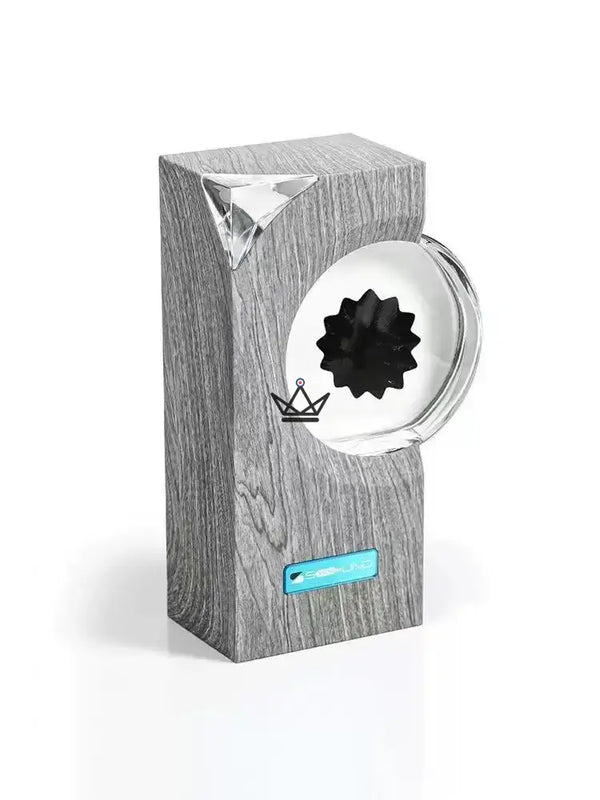
Wooden housing Ferrofluid Music finally becomes visible. The ONDA ferrofluid speaker combines a small portable speaker with a glass porthole housing black ferrofluid: a liquid filled with magnetic particles that bristles with spikes, ripples, and falls back to the rhythm of the sound. Every bass note and every percussion beat translates into an ephemeral liquid sculpture, different for every track. The vertical wooden housing comes in two grain finishes, grey or light natural, accented by a blue porthole and triangle on the front. Thanks to its built-in battery, rated for approximately 12 hours of use, it charges via USB-C port and moves freely from desk to living room. A small green magnet-stylus accompanies the speaker in the manufacturer's photos, allowing you to play with the liquid manually. Neither a flashy gadget nor a simple speaker, ONDA is a scientific curiosity that turns listening into a hypnotic spectacle, naturally finding its place in our Lab universe.
The two wood finishes
Ferrofluid: a liquid that obeys magnets
Ferrofluid is a suspension of nanoscale iron oxide particles, coated with a surfactant to prevent clumping, in a carrier liquid. It was developed in the 1960s as part of space research to control fuel movement in zero gravity. At rest, it behaves like a black, shiny oil; but as soon as a magnetic field approaches, each particle aligns with the field lines, and the entire liquid rises into regular spikes.
These spikes, known as the Rosensweig instability, result from an equilibrium between magnetic force, gravity, and surface tension. In the speaker, an electromagnet placed under the porthole varies the magnetic field based on the audio signal: the more intense the sound, the higher the spikes rise. The liquid thus becomes a true analog music visualizer.
This fascinating property explains why ferrofluid has become a favorite material for artists and designers: it makes a force that we never see—magnetism—perceptible. In industrial applications, it is notably used as a hermetic seal around rotating shafts or to dampen and cool certain speakers. Here, it leaves the inside of the machine to be displayed behind glass, like a little home laboratory experiment.
Why you will love it
When sound takes shape
We have long sought to "see" music. In the 18th century, physicist Ernst Chladni sprinkled sand on metal plates and vibrated them with a bow: the sand drew geometric figures revealing invisible waves. ONDA follows in this tradition, with a material Chladni could not have imagined: a magnetic liquid.
Sitting on a shelf, the speaker remains discreet, a simple wooden case with a dark porthole. Start a track and the liquid awakens: black thorns rise to a bass drum, quiver to a bassline, and settle into silence. Jazz gives it feline suppleness, electro a nervous energy, and classical music provides slow breathing. The wood brings warmth, the ferrofluid mystery: a dialogue between natural material and cutting-edge physics, to be listened to as much as it is watched.
Getting started in 4 steps
Ferrofluid speaker or display ferrofluid?
| Criteria | ONDA Speaker | Lab display ferrofluid |
|---|---|---|
| Principle | Electromagnet driven by sound | Hand-manipulated magnet |
| Audio function | Yes, built-in speaker | No |
| Animation | Automatic, rhythmic to music | Manual, based on your gestures |
| Power | Rechargeable battery, USB-C | None |
| Housing | Grey or natural grained wood | Varies by model |
| Ideal use | Living room, office, musical evening | Desk object for manipulation |
Good to know: ferrofluid reacts mainly to low frequencies and volume variations. Very soft tracks or low-volume playback will produce subtle movements; a track rich in percussion will make the liquid dance spectacularly. Find other fascinating experiments involving matter in our minerals and chemistry collection.
The closed porthole protects the liquid from air and dust. Main precautions concern heat, shocks, and transport, which can disperse the ferrofluid or leave marks on the inner wall. Passing the magnet-stylus over it is usually enough to restore its appearance.
Tip: If the liquid seems dispersed or stuck to the wall after a long period of disuse, gently bring the green magnet-stylus (visible in the manufacturer's photos) closer to gather it. Avoid shaking the speaker: a clean porthole and well-grouped liquid ensure the most beautiful patterns.
Ambiance tip: Place the speaker at eye level in soft, side-lighting: the reflections on the black spikes will be even more graphical.
Technical specifications
| Type | Portable speaker with ferrofluid visualizer |
| Housing | Wood, grey or natural light grain |
| Porthole | Round, glass |
| Animation | Black ferrofluid reacting to sound |
| Channels | 1 full-range speaker |
| Battery | Built-in, approx. 12h rated |
| Charging | USB-C port, 5V USB power supply |
| Mains adapter | Not included |
| Application | None required |
| Control | On/off switch |
| Water resistance | Not waterproof |
| Dimensions and weight | Not communicated |
Precautions: the speaker contains an electromagnet and, depending on the photos, a magnet-stylus: keep away from pacemaker or implantable defibrillator wearers, as well as credit cards, mechanical watches, and magnetic storage media. Never attempt to open the porthole: ferrofluid permanently stains skin, fabrics, and surfaces. Do not expose to water or heat. Keep out of reach of young children.
A gift for the ears and eyes
Birthday, Christmas, housewarming, or graduation gift: ONDA appeals to music lovers, science students, design enthusiasts, and anyone who appreciates intriguing objects. It is a gift discovered in two stages: the surprise of the object, then the wonder at the first track.
For a music-loving teenager or a young engineer, it is also a fun way to approach magnetism and fluid physics: the object naturally sparks questions, and the answers are often as fascinating as the spectacle itself.
Complete it with other curiosities from the Lab, our world of scientific objects, or with an accessory from our office and high-tech department.
Frequently asked questions
How does the ferrofluid move with the music?
Under the porthole is an electromagnet whose intensity varies based on the audio signal. The ferrofluid, filled with magnetic particles, follows these variations: when the field increases, the liquid bristles with spikes; when it decreases, it flattens out. Since the field is driven by the music, the movements follow the rhythm, percussion, and bass. This is no programmed animation: it is a real physical reaction, different for every track and even every listening session. This is what makes the show so captivating, and so different from a simple light show.
How do I connect the speaker to my music?
The speaker connects to your audio source—smartphone, tablet, or computer—according to the connection method described in the included manual. No app is necessary: once the speaker is switched on and paired with your device, just start playing. We recommend checking the manual upon receipt for the exact pairing procedure. Also, remember to adjust your source's volume: an intermediate level often provides the best figures, as the ferrofluid reacts to variations in sound rather than a constant maximum volume.
How long does the battery last?
The speaker includes a rechargeable battery with an estimated life of around 12 hours. This duration is indicative: it depends on the listening volume and the intensity of the ferrofluid's movements, as the electromagnet consumes more power when the music is loud. Charging is via the USB-C port with a 5V USB power supply. The mains adapter is not included, but a standard phone charger or computer USB port will work. To preserve the battery over time, avoid leaving it completely discharged for long periods and recharge it regularly if not in use.
Can the ferrofluid be damaged or leak?
The ferrofluid is enclosed in a sealed glass porthole, designed never to be opened. Under normal use, there is no risk of leakage. Over time, some traces may remain on the wall or the liquid may disperse: simply bring the magnet-stylus closer to gather it back up. Avoid shaking the speaker, turning it upside down, or exposing it to high heat. If the porthole were to be damaged, do not touch the liquid with bare hands: ferrofluid permanently stains skin, fabrics, and most surfaces.
Which wood finish should I choose?
Both versions are technically identical; only the housing grain differs. The grey grained wood offers a contemporary and mineral look: it pairs well with an interior featuring cool tones, black, metal, or concrete, and is well-suited for a modern office or home studio area. The natural grained wood, light yellow, brings Scandinavian warmth: it matches blonde woods, linen, plants, and bright interiors. In both cases, the contrast with the black ferrofluid and blue front accents remains striking.
What is the green magnet-stylus for?
In the manufacturer's photos, the speaker is accompanied by a small green magnet-stylus. It allows you to play manually with the ferrofluid by bringing it near the porthole: the liquid moves, rises, and follows your gestures, even without music. It is also used to gather the liquid if it has dispersed after a long rest or transport. Always bring it close gently, without hitting the porthole, and keep it away from devices sensitive to magnets. Like any magnet, it must remain out of reach of young children and away from pacemaker or implantable defibrillator wearers.
Where should I install the speaker?
Place the speaker on a flat and stable surface, porthole facing you at eye level: desk, shelf, sideboard, or coffee table. Soft side-lighting brings out the shiny reflections of the ferrofluid spikes. Keep it away from screens, hard drives, mechanical watches, credit cards, and any object sensitive to magnets. The speaker is not waterproof: avoid the bathroom, the kitchen near the sink, and the outdoors in damp weather. Thanks to its battery, you can also move it easily from one room to another, for example from the desk during the day to the living room for a musical evening.
