
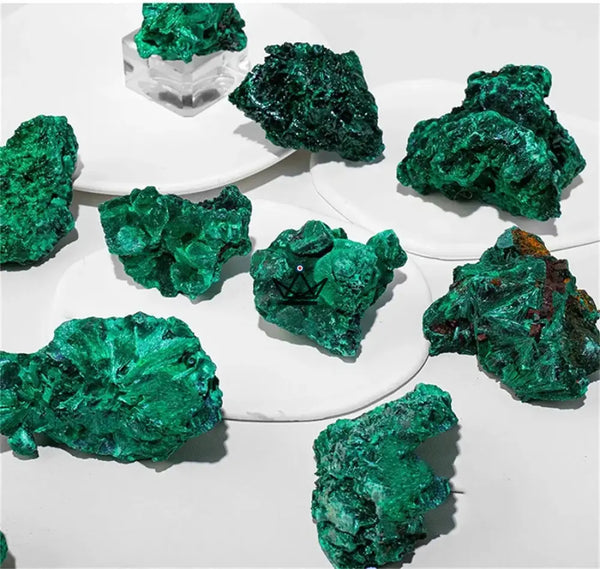
Collectible raw malachite, 100 g bag of natural stones — MALACHITE
Tax included
In the box
- 100 g bag of raw malachite (approximately 95 to 105 g)
Everything you need to know
Mineralogy Raw stone Malachite is one of the easiest minerals to recognize: an intense green crossed by light and dark concentric bands, like the growth rings of a stone tree. This bag contains approximately 100 g of raw malachite, divided into several fragments of various sizes, delivered in their natural, unpolished state, just as they were extracted from the rock. Some feature rounded, mammillated surfaces, while others show clean breaks revealing successive layers of growth. A copper carbonate formed by the slow alteration of deposits, malachite has served as a pigment for painters, an adornment for artisans, and a cladding for palaces before finding its place in collectors' drawers. This generous format allows you to compare several specimens, observe the diversity of patterns with a magnifying glass, share a few stones during a workshop, or decorate a dish with a deep green mineral décor. A wonderful introduction to mineralogy and the spirit of the cabinet of curiosities, for both natural stone enthusiasts and families curious about Earth sciences.
Malachite, the copper mineral
A copper carbonate that reveals itself in layers
Malachite is a hydroxylated copper carbonate, with the formula Cu2CO3(OH)2. It forms near the surface, in the oxidation zone of copper deposits: rainwater, laden with carbon dioxide, seeps into the rock, dissolves some of the copper, and then redeposits it layer by layer in cracks and cavities. It is this rhythmic growth that creates the highly characteristic concentric bands, alternating between light green and almost black green. Its name is said to come from the Greek malakhê, the mallow, in reference to the green of its leaves.
With a hardness of 3.5 to 4 on the Mohs scale, malachite is a soft mineral: a steel blade scratches it with ease. It is, however, dense, between 3.6 and 4, giving it a surprising weight for its size when held in the hand. Its luster varies from silky to vitreous depending on the faces, and it reacts to acids, even diluted ones, producing a slight effervescence, like all carbonates. It is often found with azurite, its blue cousin, in the same deposits.
Why you will love it
From copper mines to palace salons
Long before it was a collector's item, malachite was a color. In ancient Egypt, it was ground to make green face paint and a pigment for painting. For centuries, painters used it under the name mountain green, until synthetic pigments gradually replaced it on their palettes.
In the 19th century, the mines of the Urals in Russia produced exceptionally large blocks. Artisans cut them into thin slabs and assembled them like marquetry to clad columns, vases, and monumental tables: the famous malachite salon of the Winter Palace in Saint Petersburg remains its most renowned example. Today, much of the malachite extracted worldwide comes from the Central African copper belt, particularly from the Katanga region in the Democratic Republic of the Congo.
Holding a raw fragment in your hand allows you to rediscover the raw material of this long history, before cutting and polishing: a piece of the deposit, with its layers, hollows, and reliefs.
Discover your malachite in 4 steps
Good to know: the malachite in this bag is a natural raw specimen. Each fragment is unique: its shape, size, shade, and band pattern may differ from the photos. The weight of 100 g is approximate (about 95 to 105 g), and the number of stones varies depending on the size of the fragments. These stones are offered as objects for collecting, decoration, and discovering Earth sciences.
Tip: to bring out the bands of a raw stone, observe it under raking light, for example near a window or with a flashlight held to the side. A 10× magnifying glass also reveals the fine crystalline needles visible on some breaks. To compare hardnesses, place a quartz or calcite from your collection next to the malachite: you will see that it falls between the two.
Precautions: malachite contains copper. It is not edible and should never be put in the mouth or immersed in a drink or carafe of water, even to prepare a purported "elixir". Do not grind it, break it, or reduce it to powder: the dust should neither be inhaled nor swallowed. Wash your hands after handling and keep the stones out of reach of young children (small pieces, risk of ingestion). As a soft mineral, malachite is also sensitive to water, acids (vinegar, lemon juice), and household products, which dull and attack its surface.
Technical specifications
| Product type | Raw collectible mineral |
| Model name | MALACHITE |
| Format | Bag |
| Bag weight | Approximately 100 g (95 to 105 g) |
| Number of stones | Varies depending on the size of the fragments |
| Chemical composition | Cu2CO3(OH)2, hydroxylated copper carbonate |
| Crystal system | Monoclinic |
| Hardness | 3.5 to 4 on the Mohs scale |
| Density | Approximately 3.6 to 4 |
| Color | Light green to dark green, concentric bands |
| Finish | Raw, unpolished |
| Maintenance | Soft brush or dry cloth, without water |
A gift idea for curious minds
A bag of malachite will delight a child passionate about rocks, a mineralogy enthusiast completing their collection, or a teacher preparing a workshop on rocks and minerals. Accompanied by a magnifying glass and a small compartmented box, it becomes a real discovery kit, and its deep green also makes it a beautiful object to place on a desk or shelf.
To go further, put together a pack of four raw minerals to pair with the malachite, or explore our other scientific curiosities.
Frequently asked questions
Is the malachite in this bag natural?
Yes. It is raw natural malachite, neither dyed, reconstituted, nor polished. The fragments are delivered just as they were extracted, with their edges, mammillated surfaces, and breaks. This is precisely what makes them interesting to a collector: on a raw stone, you can observe how the mineral actually formed, while polishing erases some of these clues. Malachite has a green color characteristic of the copper it contains, with bands that are more or less pronounced depending on the fragments. As with any natural specimen, the shade, shape, and band pattern vary from one stone to another and may differ from the photos.
How many stones does the 100 g bag contain?
The bag is sold by weight and not by piece: it contains approximately 100 g of malachite, or between 95 and 105 g depending on the weighing. The number of stones is therefore not fixed: it depends on the size of the fragments, which varies from one batch to another. A bag may thus contain a few large pieces accompanied by smaller fragments, or more medium-sized stones. In any case, this format allows you to have several specimens to compare, sort by pattern, or share. If you are looking for a stone of a specific size, contact our customer service before placing your order.
Why does malachite have bands?
The bands of malachite tell the story of its growth. The mineral forms when copper-laden waters circulate through the rock and deposit their contents, layer after layer, in cracks and cavities. Each variation in the composition of the water, its flow rate, or the conditions of the environment slightly alters the size of the crystals, and therefore the shade of green. The result is an alternation of light and dark bands, often concentric around a starting point, like the growth rings of a tree. On a raw stone, these patterns are mainly visible on the breaks; the outer surfaces, on the other hand, show rounded, clustered shapes, known as mammillated.
Can malachite be handled safely?
Malachite can be viewed and handled like any other collectible stone, provided you follow a few simple rules related to the presence of copper in its composition. Never put it in your mouth, do not grind it, and do not reduce it to powder, so as not to inhale or swallow dust. Wash your hands after touching it, especially before eating. Keep the stones out of reach of young children, as they are small pieces that could be swallowed. For a workshop with older children, plan for adult supervision and hand washing at the end of the activity.
Can malachite be put in water?
No. Malachite is a soft and sensitive mineral: water, and especially acidic liquids, can dull its surface and alter its luster. Above all, it contains copper: it should never be immersed in a drink, a water bottle, or a carafe, nor used to prepare water or an "elixir" intended for drinking. For cleaning, a soft brush or a dry cloth is sufficient. If a stone has been accidentally wetted, wipe it off immediately and let it air dry. Also avoid vinegar, lemon juice, and household products, which attack carbonates.
How to store and display malachite?
With a hardness of 3.5 to 4, malachite scratches easily when in contact with harder stones such as quartz, corundum, or tourmaline. Therefore, store it separately, in a compartmented box, a small display case, or a dish reserved for it. Avoid damp places, such as a bathroom, and heat sources. For a collection, a label for each fragment with the mineral's name, its formula, and its hardness immediately gives it the appearance of a cabinet of curiosities. Dust regularly with a soft brush and wash your hands after each handling.
What other minerals can malachite be paired with?
Malachite pairs very well with minerals of contrasting colors: the deep blue of lapis lazuli, the metallic gold of pyrite, the purple of amethyst, or the transparency of rock crystal. To put together a small educational collection, you can gather minerals from different families and compare their hardnesses, lusters, and colors. Our raw minerals to collect pack allows you to choose four natural stones from a wide selection, or opt for a 100 g bag of the same mineral, to complete your malachite collection family by family.
