


Blackboard math equations wall clock - THEOREMA
🚚 FREE DELIVERY
Tax included
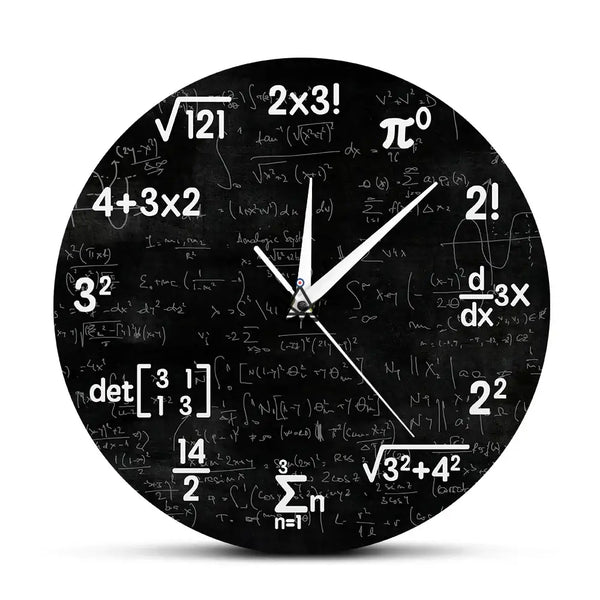
The Lab Mathematics Factorials, derivatives, determinants, series sums: the THEOREMA blackboard wall clock is designed for those who see mathematics as a playground. Its round 30 cm diameter dial reproduces the look of a school chalkboard covered in calculations, with each hour replaced by a mathematical expression: π⁰ for 1, 2! for 2, the derivative of 3x for 3, √(3²+4²) for 5, the determinant of a matrix for 8, 2×3! for 12. Two white hands stand out against this busy background, powered by a quartz movement. Two versions are available: with a black metal frame and acrylic glass protecting the dial for a more assertive look, or without a frame or glass for a raw, authentic blackboard feel. Hung in an office, library, classroom, or laboratory, it pays homage to the formulas once written in chalk, inviting every visitor to a small challenge: deciphering the time behind each expression.
The two versions available
The dial, expressions, and movement are identical in both versions. The metal frame adds a clean line around the dial and includes acrylic glass to protect it from dust; the frameless version offers a direct view of the dial with no glare and a lighter profile.
Twelve hours, twelve mathematical concepts
Each position on the dial corresponds to a different concept. At 1 o'clock, π⁰ reminds us that any non-zero number to the power of zero equals 1. At 2 o'clock, 2! (factorial of 2) equals 2. At 3 o'clock, the derivative of 3x with respect to x equals 3. At 4 o'clock, 2²; at 5 o'clock, √(3²+4²) evokes the famous 3-4-5 right triangle and the Pythagorean theorem. At 6 o'clock, the sum of integers from 1 to 3 equals 6.
The rest of the dial is just as rich: 14/2 for 7, the determinant of the matrix [3 1 ; 1 3], i.e., 3×3 − 1×1 = 8, for 8 o'clock; 3² for 9; 4+3×2, testing order of operations, for 10; √121 for 11; and finally 2×3!, or 2×6, for noon. With twelve expressions, the clock covers algebra, analysis, geometry, and linear algebra: a true revision curriculum hanging on your wall.
Why you'll love it
The blackboard never gets erased
Anyone who has spent hours in front of a chalk-covered board will recognize this atmosphere: the calculations in the background, the overlapping formulas, the proof progressing line by line. THEOREMA captures this moment and transforms it into an everyday object. Amidst this abundance, the twelve expressions on the dial read like so many small victories.
With its black metal frame, the clock takes on the air of a laboratory instrument; without a frame, it evokes the classroom slate directly. In either case, it appeals to minds that love to understand, to teachers who pass on knowledge, and to engineers and researchers who know that a well-written formula has its own elegance.
Installing your THEOREMA clock
THEOREMA or black background math clock?
| Criteria | THEOREMA (this clock) | Black background math clock |
|---|---|---|
| Dial | School chalkboard style, covered in calculations | Solid black background, white chalk operations |
| Expressions | Factorials, derivatives, determinants, sums, roots | Multiplications, roots, proportions, equations |
| Level | High school, university | Mental math, middle and high school |
| Diameter | 30 cm | Approx. 25, 30, 35 or 40 cm |
| Frame | Black metal frame and acrylic glass, or frameless | Frameless, light wood back |
| Material (supplier) | Acrylic / plastic | Bamboo and wood |
The Lab offers another mathematical clock with a solid black background and more accessible operations, available in four diameters. Find it with our other time-themed items in the time and weather objects collection.
Good to know: depending on the supplier, the clock is made of acrylic and plastic, with a 30 cm diameter. On the framed version, black metal surrounds the dial and acrylic glass protects it. The battery is not included. The time is also very easy to read simply by the position of the hands, without solving the expressions.
Advice: the frameless version avoids reflections from a window or lamp on the dial; the framed version protects the dial from dust and is well-suited for kitchens and high-traffic areas. For a brightly lit office, opt for the frameless version.
Technical specifications
| Type | Round wall clock with mathematical dial |
| Dial | Black, school chalkboard aspect covered in calculations |
| Hour indications | Mathematical expressions (π⁰, 2!, d/dx 3x, √(3²+4²), determinant…) |
| Hands | White |
| Diameter | 30 cm |
| Metal frame version | Black metal frame and acrylic glass |
| Frameless version | Dial without frame or glass |
| Material (supplier) | Acrylic / plastic |
| Movement | Quartz |
| Power source | Battery (not included; type not specified) |
| Mounting | Wall |
| Weight | Not specified |
Precautions: keep the battery out of reach of children: if swallowed, consult a doctor immediately. Remove the battery if not in use for a long period and dispose of it at an appropriate collection point. Attach the clock to a support suitable for the wall type. Clean the dial or acrylic glass with a soft, dry cloth; do not use abrasive products or solvents, which could scratch or dull the surface.
A gift for scientific minds
THEOREMA is the ideal gift for a mathematics or physics teacher, a preparatory class student, an engineer, or a researcher. It celebrates a high school diploma, graduation, retirement, or setting up a new office.
To complete this gift, discover The Lab's scientific objects or our puzzles and office objects.
Frequently asked questions
Which expressions appear on the dial?
Each hour is represented by a mathematical expression: π⁰ for 1, 2! for 2, the derivative of 3x for 3, 2² for 4, √(3²+4²) for 5, the sum of integers from 1 to 3 for 6, 14/2 for 7, the determinant of the matrix [3 1 ; 1 3] for 8, 3² for 9, 4+3×2 for 10, √121 for 11, and 2×3! for 12. These expressions span several fields: powers, factorials, analysis, geometry, sums, and linear algebra. The background of the dial is also covered in decorative calculations, which enhance the blackboard effect without interfering with reading the hours and hands.
Do you have to be a mathematician to read the time?
Not at all. The hands work like on any clock: the short one points to the hours, the long one to the minutes, and their position is enough to read the time, exactly like on a dial without numbers. The mathematical expressions are an optional game: the curious will enjoy checking each result, while others will simply enjoy the aesthetics of the blackboard. Some expressions are accessible to everyone, like 14/2 or 3²; others, like the derivative or the determinant, will draw on memories of high school or university studies, and can spark lively discussions with your guests.
What is the difference between the framed and frameless versions?
The framed version is surrounded by a black metal circle and features acrylic glass in front of the dial. It offers a more assertive profile, close to an office or laboratory clock, and protects the dial from dust and fingerprints. The frameless version presents the bare dial without glass: its rendering is rawer, very close to a classroom slate, and it produces no reflections, even facing a window. The 30 cm diameter, dial, hands, and quartz movement are identical in both versions: the choice depends on your interior decor and the room's lighting.
What battery should be used, and is it provided?
The clock runs on a quartz movement powered by a battery. The battery is not included: remember to provide one before installation, especially if giving it as a gift. The exact type of battery was not provided to us by our supplier; movements of this format generally run on an AA battery, but we invite you to check the compartment on the back of the clock upon receipt. Insert the battery observing the indicated polarity, then set the time using the wheel. When the clock starts lagging or stops, simply replace the battery.
What is the difference from The Lab's other math clock?
The Lab offers two complementary mathematical clocks. THEOREMA features a school chalkboard-style dial entirely covered in calculations, with high school and university-level expressions: factorials, derivatives, determinants, sums. It measures 30 cm and comes with a metal frame and acrylic glass or frameless. The other model features a solid black background against which more accessible mental math operations stand out, such as multiplications, square roots, and simple equations; it is offered in four diameters, from approximately 25 to 40 cm, with a light wood back. THEOREMA is the more scholarly of the two.
How do I maintain the clock?
Very simple maintenance is sufficient. For the framed version, dust the acrylic glass and metal frame with a soft, dry cloth, or a slightly damp microfiber cloth for fingerprints. Avoid abrasive products, alcohol, and solvents, which could scratch or dull the acrylic. For the frameless version, as the dial is exposed, use only a soft, dry cloth without rubbing hard, in order to preserve the calculation print. In all cases, avoid installation in a very humid room or in direct sunlight, which could alter the dial's colors over time.
Is this clock silent?
The clock is equipped with a quartz movement, but our supplier does not specify if it is a continuous sweep movement, known to be silent, or a classic ticking movement. We therefore prefer not to promise completely silent operation. For a bedroom or a room where the slightest noise matters, the other math clock from The Lab, whose movement is described as silent by the manufacturer, may be an alternative to consider. For an office, library, kitchen, or classroom, the noise issue is generally secondary, and THEOREMA fits perfectly.
