

Low-Temperature Stirling Engine - ALDABERT DIY Kit
Tax included
In the box
- 1 low-temperature Stirling engine, assembled
- User manual (in English)
Everything you need to know
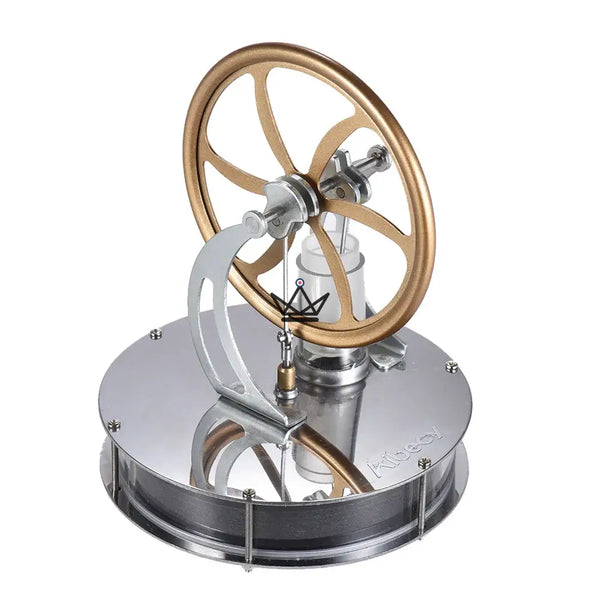
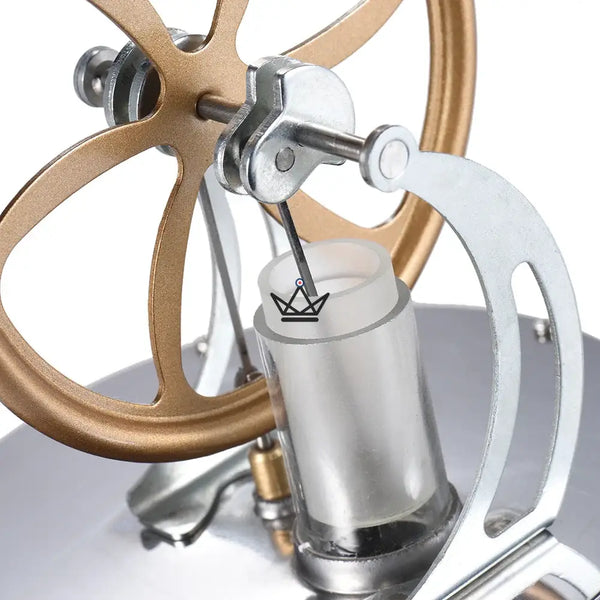
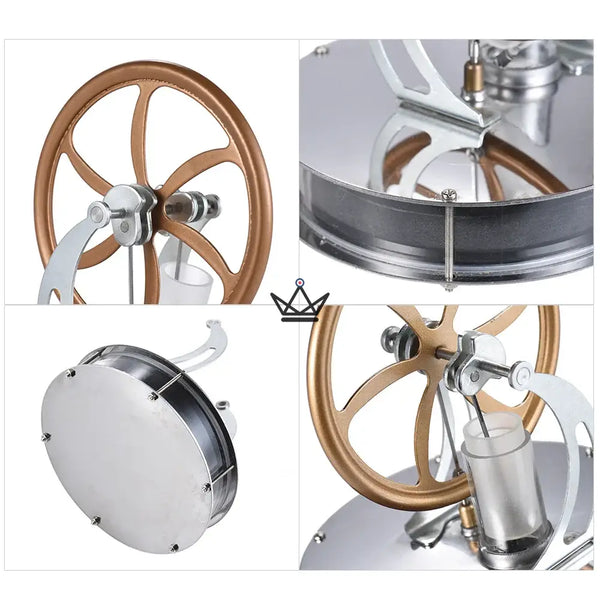
The ALDABERT-001 low-temperature Stirling engine is one of the most fascinating scientific demonstration objects to observe. Designed to operate with a simple cup of hot water without any flame or combustion, it transforms a temperature difference as low as 25 °C into a self-sustaining rotational movement of the golden wheel, up to 180 revolutions per minute. A true condensation of applied thermodynamics displayed on a desk or shelf. Body made of stainless steel and painted carbon steel, frosted glass piston resistant to leaks and wear, compact size 12.2 × 10.2 × 10.2 cm for 250 g. Ideal for mechanics enthusiasts, physics teachers, engineering students, collectors of scientific objects, or any lover of elegant objects that demonstrate fundamental physical principles. User manual included. Scientific Demonstration Thermodynamics
ALDABERT-001 Stirling engine advantages
How does a Stirling engine work?
The Stirling engine is a heat engine invented in 1816 by the Scottish pastor Robert Stirling, which exploits the expansion and contraction of a gas under the effect of a temperature difference. Unlike internal combustion engines (gasoline, diesel), it requires no explosion or internal combustion — the heat source can be entirely external and of any nature: flame, sun, friction, human heat, and in the case of the low-temperature model, a simple cup of hot water.
The principle is elegant: when the air trapped in the cylinder comes into contact with the hot base, it expands and pushes the piston; when it is then moved to the cold zone (top of the cylinder exposed to ambient air), it contracts and pulls the piston in the opposite direction. This cycle repeats as long as the thermal difference is maintained, creating a continuous and autonomous rotational movement — fascinating to observe and particularly educational.
The ALDABERT-001 is a "low-temperature" model: while most commercial Stirling engines require a flame or an intense heat source, this model is calibrated to start with only a 25 °C difference between the base and ambient air — which makes it safe, accessible to accompanied children, and usable daily without special equipment.
📦 Package Contents
Starting the engine in 4 steps
For best performance: use a very hot cup of water (80-90 °C) just after boiling. Start the wheel in a clockwise direction — this is the nominal operating direction. If the movement becomes irregular after several uses, apply a very small amount of dry graphite lubricant to the glass piston. You can also place the engine on other heat sources: hot water bottle, radiator, slightly heated surface. Anecdote: in cold weather (ambient temperature below 12 °C), you can even run it with the heat of your hand (37 °C) — the 25 °C difference is naturally achieved!
Maintenance: The engine does not require regular maintenance. Wipe the body with a soft, dry cloth to preserve the shine of the stainless steel and the finish of the golden wheel. Avoid prolonged contact with moisture. In case of friction or slowing, apply only dry graphite lubricant (available at model shops) to the glass piston. Store away from dust between uses.
Usage precautions: Never use mineral or vegetable oil as a lubricant — oil would clog the mechanism and irreversibly reduce performance. Use exclusively dry graphite lubricant. The engine is not a toy for young children — it contains moving mechanical parts and comes into contact with a hot source. Adult supervision is recommended for educational use with children. Keep out of reach of very young children.
Technical specifications
| Model | ALDABERT-001 |
| Type | Low-temperature Stirling engine |
| Materials | Stainless steel + painted carbon steel + glass |
| Piston | Frosted glass, anti-leak and anti-wear |
| Wheel | Golden (gold finish) |
| Dimensions | 12.2 × 10.2 × 10.2 cm |
| Weight | 250 g |
| Maximum speed | 180 rpm |
| Minimum temperature difference | 25 °C (base vs ambient air) |
| Heat source | Cup of hot water, hot water bottle, radiator (no flame required) |
| Recommended lubricant | Dry graphite only (never oil) |
| Manual | Included, in English |
The ultimate thermodynamic gift
The ALDABERT-001 Stirling engine is an original and memorable gift that stands out from the crowd. It combines aesthetic elegance (stainless steel, glass, golden wheel), educational dimension (a living demonstration of thermodynamic principles), and an interactive character (the object actually works and fascinates with every use). Ideal for a science enthusiast's birthday, Father's Day, Christmas, a teacher's gift in physics or engineering, a thank-you gift for a professor, a professional promotion gift for an engineer, or a retirement gift. Particularly suitable for teachers, engineering students, engineers, collectors of scientific objects, clockwork mechanics enthusiasts, or simply people curious about how the world works. A gift like no other.
