

Medieval ballista wooden 3D puzzle with figurine and projectiles — VELITE
Tax included
In the box
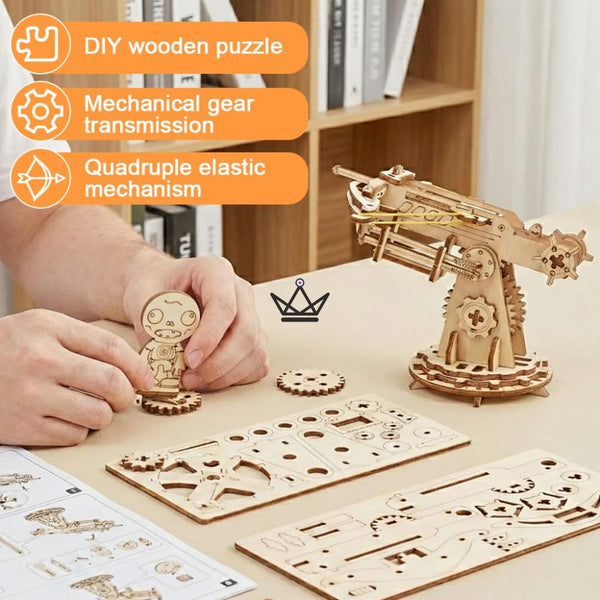
- Pre-cut plywood sheets
- 1 wooden figurine
- Wooden projectiles
- 4 rubber bands
- 1 instruction manual
Everything you need to know
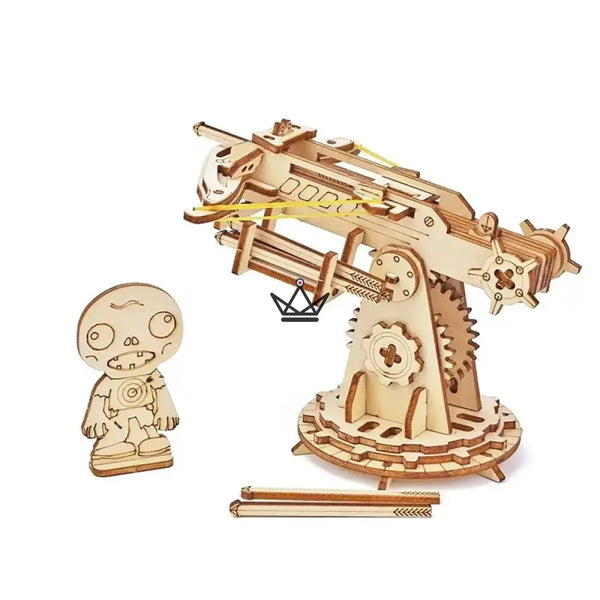
Laser-cut wood Siege mechanics Before gunpowder, military engineers in antiquity and the Middle Ages vied in ingenuity to project bolts ever further. The VELITE wood 3D puzzle ballista invites you to reconstruct one of their most formidable machines: a medieval ballista made of light-colored plywood, laser-cut, featuring a horizontal bow powered by four rubber bands, a gear transmission, a lifting rack to adjust the inclination, a firing trigger, and a pivoting turret that allows you to aim the device. The kit comes with a small wooden figurine—the machine operator—as well as wooden projectiles shaped like rods, to help understand how energy is concretely stored and then released. Intended for adults and teenagers aged 14 and up, this model is assembled by interlocking parts and combines the pleasure of construction, a lesson in mechanics, and a decorative piece with a strong personality. Once finished, measuring about 14 cm long and 9 cm high, it will find its place on a desk, in a history library, or in the middle of a figurine collection.
The model offered
Storing energy, then releasing it: the mechanics of the ballista
The ballista is a bolt-thrower developed by Greek engineers and later perfected by the Romans, who used it both during sieges and on ramparts. Its principle can be summarized in one sentence: you accumulate elastic energy by tensioning a bow or bundles of twisted ropes, then release it in one go onto the projectile. The winch plays a key role: thanks to the leverage effect of its crank and axle, it allows a rope to be tightened much more strongly than with arms alone.
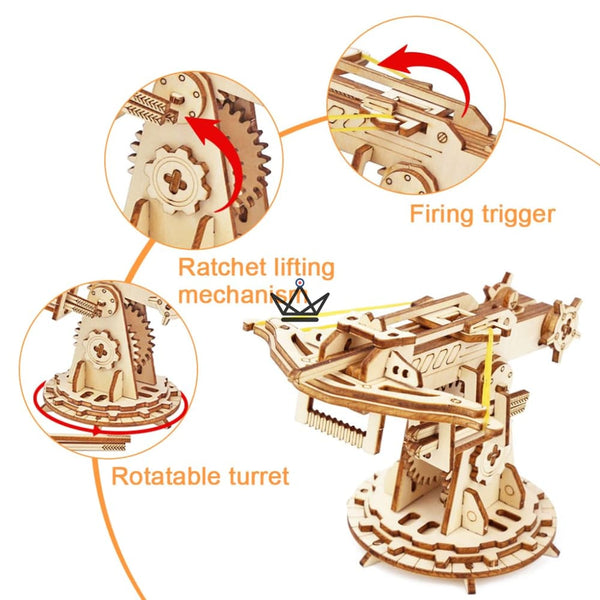
In the Middle Ages, large rampart crossbows and espringals extended this family of engines. The pivot of the carriage allows for lateral aiming, while the rigidity of the frame determines the precision of the shot. By rebuilding VELITE, one sees very concretely how these elements articulate to form a real machine: four rubber bands serve as an energy reservoir, a gear transmission arms the mechanism, a ratchet rack adjusts the inclination, a trigger releases the shot, and a pivoting turret ensures lateral aiming.
Why you will love it
On the wall walk
Dawn breaks over a besieged citadel. On the wall walk, an operator turns the winch in small, steady movements; the rope tightens, the wood of the bow groans. His captain adjusts the carriage a quarter-turn on its pivot, aims at the approaching siege tower, and waits for the signal. For centuries, these precise movements decided the fate of strongholds.
VELITE captures this suspended moment in light wood. The operator figurine, placed next to the machine, tells the story of artillerymen before artillery—technicians who intuitively understood the laws of leverage and elasticity long before they were written into equations.
Displayed on a shelf, the ballista no longer threatens anyone: it becomes a witness to human ingenuity and an excellent entry point for discussing history and physics with a curious teenager.
Assemble and display the ballista
Ballista, catapult, or trebuchet?
| Criteria | Ballista (VELITE model) | Torsion catapult | Counterweight trebuchet |
|---|---|---|---|
| Energy source | Tension of a bow or ropes (four rubber bands in the model) | Torsion of a rope bundle | Falling of a counterweight |
| Typical projectile | Bolts, quarrels | Stones | Large stone blocks |
| Trajectory | Flat, mostly horizontal | High-arched | Steeply arched |
| Strength | Shooting precision | Compactness | Power |
| Tension system | Winch (gear transmission in the model) | Winch or lever | Winch to raise the counterweight |
| Included in this kit | Yes, approx. 14 × 7.5 × 9 cm, with figurine and wooden projectiles | No | No |
Good to know: the manufacturer's photos do advertise a firing function (trigger, four-rubber-band bow), but specify neither the power of the mechanism, nor the range of the projectiles, nor their exact number (two wooden bolts are visible). VELITE is primarily a historical and decorative model; we do not present it as a firing toy.
Tip: for a successful presentation, orient the ballista at a three-quarter angle, bow facing into the room, and place the figurine near the trigger as if it were about to fire. Store the projectiles in a small box nearby so as not to misplace them.
Technical specifications
| Product type | 3D wooden puzzle, mechanical model to build |
| Model | Medieval ballista |
| Material | Light-colored plywood |
| Parts manufacturing | Laser cutting and engraving |
| Assembly | Interlocking parts |
| Mechanical elements | Four-rubber-band bow, gear transmission, ratchet rack for inclination, firing trigger, pivoting turret |
| Accessories provided | Small wooden figurine, wooden projectiles (bolts) |
| Number of projectiles | Not communicated (two bolts visible in photos) |
| Power and range | Not communicated |
| Recommended age | 14 years and up |
| Certification | CE |
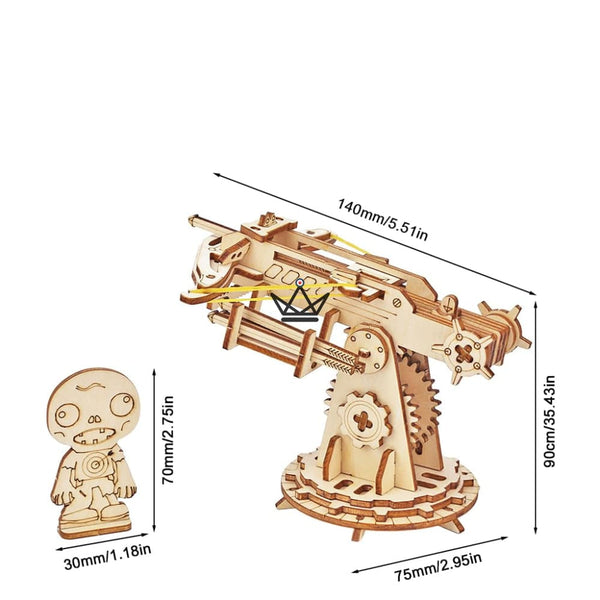
| Dimensions once assembled | Ballista: approx. 14 cm long, approx. 7.5 cm base, approx. 9 cm high |
| Figurine | Approx. 3 cm wide × 7 cm high |
| Number of parts | Not communicated |
Precautions: never aim at a person or animal, even while playing, and never look down the axis of the machine when it is loaded. The kit contains small parts and projectiles not suitable for children under 3 years old; recommended for ages 14+. Never replace the provided projectiles with hard or sharp objects, and do not leave the ballista loaded unattended. Keep the model away from fire, as indicated by the manufacturer.
A gift for strategists and curious minds
VELITE will delight medieval history enthusiasts, fans of strategy games and reenactment, regular visitors to castles, and high school students preparing presentations on war machines. It makes a great gift for a birthday, Christmas, Father's Day, or as a colleague gift for an engineer who loves to understand how things work.
To continue the discovery, browse our other puzzles and wooden models, the Labo's physics and movement collection, as well as all of our scientific objects.
Frequently Asked Questions
Can the VELITE ballista really fire?
Yes, a firing function is advertised: the bow is powered by four rubber bands, a gear transmission arms the mechanism, a ratchet rack adjusts the inclination, and a trigger releases the bolt. The model comes with wooden projectiles. However, the manufacturer does not communicate the power of the mechanism or the range of the shots. Therefore, we present it primarily as a historical and decorative model. If you operate the mechanism, do so with moderation, always towards an inanimate target and in an open space. Never aim at a person or animal, and do not leave the model loaded permanently: prolonged tension fatigues the wood of the bow.
What exactly does the kit contain?
According to available information, the kit includes laser-cut pieces in light-colored plywood to build the ballista, a small wooden figurine representing the machine operator, about 7 cm tall, and wooden projectiles shaped like bolts (two are visible in the photos). The mechanism works with four rubber bands, and the assembly is guided by a manual and pre-cut boards. The exact number of parts and projectiles is not communicated by the manufacturer. Assembly is done by interlocking parts. Check the contents of the boards before starting and keep the projectiles in a small box so they don't get lost once the model is displayed.
What is the difference between a ballista and a catapult?
They are often confused, but their operation differs. The ballista stores its energy in the tension of a bow or ropes and projects bolts along a flat trajectory, almost horizontal: it is a precision weapon, similar to a giant crossbow. The catapult uses a pivoting arm to launch stones in an arched trajectory, to pass over walls. As for the trebuchet, it derives its power from the fall of a heavy counterweight. VELITE illustrates the first principle, with four rubber bands for propulsion, a rack for adjusting inclination, and a pivoting turret for aiming.
Is this model suitable for a teenager?
Yes, the manufacturer recommends it for ages 14 and up. The assembly stimulates plan reading, precision, and the understanding of mechanics, and the subject often fascinates teenagers attracted to history or strategy games. We do, however, advise that an adult reiterate the safety rules before any manipulation of the mechanism: never aim at a person or animal, do not look down the firing axis, and do not replace the provided projectiles with hard or sharp objects. Younger children should be kept away from small parts and rods.
How long does it take to build?
The manufacturer does not specify the number of parts or the assembly time, and we do not wish to invent a figure. Construction naturally breaks down into three stages: the pivoting base, the carriage with its gear transmission, and finally the bow, its rubber bands, and the staging. This progression allows you to work in several sessions without losing track. The part requiring the most care is generally the bow and the gears, as their proper alignment conditions the mechanism's function. Take the time to verify that each element moves freely before moving to the next.
Does the pivot allow the ballista to be aimed?
Yes, the ballista rests on a pivoting turret, as shown in the manufacturer's photos, which reproduces the lateral aiming of historical rampart engines. A ratchet rack also allows the inclination of the bow to be adjusted. This lets you choose the orientation of the machine for display: three-quarter view, profile, or facing the room. Handle the pivot gently, holding the base with one hand and the carriage with the other, rather than pushing on the bow. If the rotation becomes stiff after assembly, check that no tab is sticking out and rubbing; a light fine sanding is usually enough to restore smooth movement.
How to preserve the model over time?
Avoid leaving the bow and its rubber bands under tension permanently: the wood, if stressed for a long time, loses its flexibility. Display VELITE at rest, away from direct sunlight, humidity, and, as requested by the manufacturer, away from any flame or heat source. Dust it with a soft brush that can pass between the gears and the carriage parts. Keep the figurine and projectiles in a small box when not using them for display. Finally, move the model by holding it by its base, never by the bow, which remains the most stressed part.
