


Twin-cylinder Stirling engine with generator and LED - CASTOR
🚚 FREE DELIVERY
Tax included
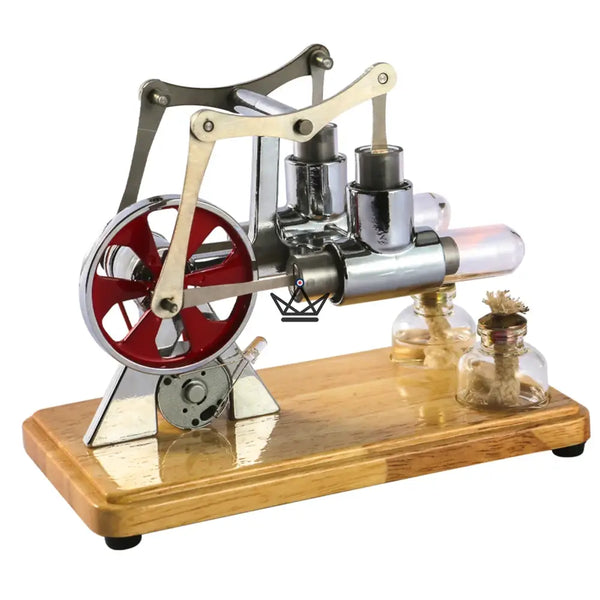
Hot air engine Wooden base Two cylinders, a flame, and the mechanics awaken. This twin-cylinder Stirling engine is a true hot air engine in miniature: heated by two glass alcohol lamps, its horizontal cylinders set a rocker, connecting rods, and a red spoked flywheel in motion. This movement in turn drives a small generator that lights an LED: in a few moments, heat becomes movement, then electricity, right before your eyes. Mounted on a light wood base, the assembly combines the precision of metallic parts with the charm of a scientific cabinet object. Two finishes are available, silver or brass-style gold, at 1:12 scale according to the manufacturer. Recommended for ages 14 and up, this model is aimed at mechanical enthusiasts, teachers, engineers, and anyone who loves to see physics in action, whether on a desk or a bookshelf.
Available finishes
The Stirling cycle: when heat becomes movement
Invented in 1816 by the Scottish clergyman Robert Stirling, this engine works without explosions or valves: a fixed volume of gas, in this case air, is trapped in the engine and alternately heated and cooled. When heated, the air expands and pushes a piston; when cooled, it contracts and the piston returns. The temperature difference between the hot part, above the flame, and the cold part is enough to maintain continuous movement, transmitted by connecting rods to the flywheel, whose momentum regulates the rotation.
In the twin-cylinder configuration, the pistons work in an offset manner, making the movement more regular and more spectacular to observe. The Stirling engine is renowned for its quiet operation and its ability to harness almost any heat source; it is currently studied for energy recovery and solar power. The small generator added to this model illustrates the final stage of the chain: thermal energy becomes mechanical, then electrical.
Why you will love it
Two centuries of mechanical genius
In 1816, during the height of the Industrial Revolution, steam engines were exploding regularly. Robert Stirling then imagined a safer engine, without a pressurized boiler, requiring only a heat source and a little trapped air. Two centuries later, his invention continues to inspire engineers and researchers.
This twin-cylinder model offers a desk-sized version, featuring the most fascinating aspects of mechanics: the ballet of the rods, the oscillating rocker, the red flywheel gaining momentum, and that little LED lighting up like a reward.
Light the lamps, wait a few moments, and give the flywheel a nudge: the machine comes to life with a light ticking. This is exactly what we love to gather in our Physics & Movement collection: objects that aren't just beautiful, but actually work.
Starting the engine
Comparison: which Stirling engine to choose?
| Criteria | Twin-cylinder with generator (this model) | Labo low-temperature Stirling | Labo Stirling assembly kit |
|---|---|---|---|
| Heat source | Two alcohol lamps | Small temperature difference (hand, hot cup) | Varies by model |
| Mechanical spectacle | Two cylinders, rocker, red flywheel | Slow and silent movement | Pleasure of assembly |
| Electricity production | Yes, generator and LED | See specific product page | See specific product page |
| Open flame | Yes | No | Varies by model |
| Ideal audience | Mechanical enthusiasts, teachers (14+) | Desk, gentle demonstration | DIYers, model makers |
Good to know: a Stirling engine does not start instantly. The cylinders must be allowed to heat for a few moments to create a sufficient temperature difference, then the flywheel must be started by hand. The engine only turns as long as the flame is maintained; it stops on its own when the lamps are extinguished and the cylinders cool down. This is in no way a perpetual motion machine.
Tip: for a demonstration in a classroom or in front of guests, dim the room lights: the little generator LED becomes clearly visible and makes the energy conversion very clear. If the flywheel struggles to start, wait a few more seconds before restarting, and check that the wicks are centered under the cylinders.
Technical specifications
| Type | Hot air Stirling engine, two horizontal cylinders |
| Finishes | Silver · Brass-style gold |
| Material | Metal; light wood base |
| Flywheel | Red, spoked |
| Generator | Driven by the engine, powers an LED |
| Heat source | Two glass alcohol lamps (visible in photos) |
| Fuel | Methylated spirits, not included |
| Announced scale | 1:12 (according to manufacturer) |
| Approximate dimensions | About 17.5 × 9.5 cm base, 13 cm height |
| Recommended age | 14 years and older |
| Announced compliance | CE (according to manufacturer) |
| Delivery | Assembled or kit (not specified) |
Precautions — open flame: never leave the engine running unattended. Use on a stable, non-flammable surface, away from curtains, paper, and flammable materials. Fill lamps only when flames are extinguished and lamps are cold, and store alcohol out of reach of children. The cylinders remain burning hot for several minutes after extinguishing: do not touch. Small parts: not suitable for children under 14 without adult supervision.
A gift that makes engineers' eyes shine
For an engineer, a physics professor, a mechanical student, a fan of steam and vintage machines, or a curious young person over 14, this engine is a rare gift: it is meant to be admired, demonstrated, and always sparks questions. It marks a graduation, retirement, Father's Day, or a birthday.
To extend the discovery, explore the entire Labo d'Atelier Atypique, with its other Stirling engines, pendulums, and moving objects, or our Desk & Hi-tech selection.
Frequently Asked Questions
How does this Stirling engine work?
The Stirling engine is a hot air engine: air trapped in the cylinders is alternately heated by the flame of alcohol lamps and cooled on the opposite side. By expanding, the air pushes a piston; by contracting, it lets it return. This back-and-forth motion is transmitted by the rods to the flywheel, whose momentum regulates the rotation. On this twin-cylinder model, the two pistons work in an offset manner for smoother movement. The rotation finally drives a small generator that lights an LED, illustrating the transition from thermal energy to mechanical then electrical energy.
Is the alcohol included?
No, fuel is not included. The photos show two glass alcohol lamps placed under the cylinders; they are used with commercial methylated spirits, available in supermarkets or hardware stores. Fill each lamp without exceeding two-thirds, always when flames are extinguished and lamps are cold, then close carefully and wipe away any spills before lighting. Keep the alcohol bottle closed, away from any flame, and out of reach of children. Never use gasoline, lighter fluid, or any other fuel not intended for this type of lamp.
Is the engine delivered assembled?
The manufacturer does not specify if the engine is delivered fully assembled or as an assembly kit, and we prefer not to confirm on their behalf. The supplier page mentions a set of twenty elements, which may correspond to the engine parts, lamps, and accessories. In any case, take the time to check the tightness of the parts and the free movement of the flywheel before the first start. If you specifically want a model to build yourself, the Labo also offers a Stirling assembly kit, designed for the pleasure of building.
Can the engine run indefinitely?
No. The Stirling engine is not a perpetual motion machine, which would be physically impossible: it needs a heat source to function. As long as the alcohol lamps burn and the temperature difference between the hot and cold parts of the cylinders is sufficient, it runs steadily. As soon as the flame goes out, the cylinders cool down, the temperature gap decreases, and the flywheel slows down until it stops. The operating time therefore depends on the amount of alcohol in the lamps. Do not extend demonstrations beyond reason and let cool between uses.
What is the difference between the silver and gold finishes?
Both finishes share the same mechanics, the same red spoked flywheel, the same generator with LED, and the same light wood base. Only the appearance of the metallic parts changes. The Silver version features silver-colored cylinders and parts for a technical and contemporary look, which suits a modern office. The Gold version sports a brass-style finish, warmer, evoking antique scientific instruments and curiosity cabinets. The choice is therefore primarily aesthetic: consider the decor of the room where the engine will be displayed.
Is this engine suitable for educational use?
Yes, that is one of its major strengths. This engine allows for concrete illustration of gas expansion, the thermodynamic cycle, motion transmission via rods, and energy conversion: thermal, then mechanical, then electrical thanks to the generator and its LED. It interests physics and technology teachers, science clubs, and curious families. The manufacturer recommends it for ages 14 and up. In the presence of students or children, the demonstration must always be conducted by an adult, due to the open flame and hot parts.
How do I maintain the Stirling engine?
Always let the engine cool completely before handling or cleaning. Dust off the mechanical parts with a soft brush or a dry cloth, and wipe the wooden base with a slightly damp cloth, without aggressive products. If the movement becomes less fluid, a drop of fine oil on the joints can help, avoiding the cylinders. Empty the alcohol lamps if the engine is to remain unused for a long time, and store it away from dust. Regularly check the condition of the wicks and replace them if they are too worn to ensure a stable flame.
